
Glass Reactor
Glass Reactor
The Glass Reactor is a multifunctional jacketed reaction system designed for heating, cooling, vacuum operation, distillation, reflux, and mixing applications. Made from high borosilicate glass with excellent corrosion resistance and transparent visibility, it is widely used in pharmaceutical, chemical, biological, and laboratory industries.
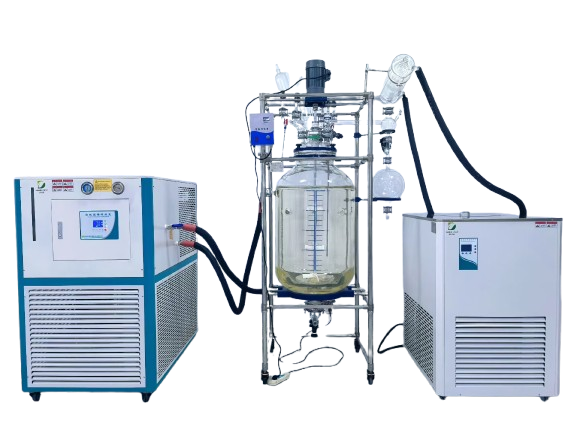
The Glass Reactor is a high-performance laboratory and pilot-scale reaction system designed for precise temperature control, vacuum processing, distillation, extraction, and material mixing applications. Manufactured using GG3.3 high borosilicate glass, the reactor offers excellent chemical resistance, thermal stability, and full process visibility for research and industrial production environments.
The double-layer jacketed design allows heating or cooling media to circulate through the outer jacket, enabling accurate temperature control during reactions. The system supports both high-temperature and low-temperature processing, making it suitable for synthesis, crystallization, extraction, reflux, concentration, and polymerization applications.
The transparent glass vessel allows operators to directly monitor color changes, phase reactions, crystallization processes, bubbles, viscosity changes, and material behavior during operation. Combined with a variable-frequency stirring system and vacuum sealing technology, the reactor provides stable and efficient processing performance.
The reactor structure uses stainless steel support frames with movable caster wheels for flexible installation and operation. PTFE sealing components provide excellent chemical resistance and reliable vacuum performance.
The Glass Reactor supports:
- Heating and cooling reactions
- Vacuum distillation
- Reflux processing
- Solvent recovery
- Crystallization
- Material extraction
- Stirring and mixing
- Controlled feeding operations
The system is widely used in pharmaceutical production, chemical synthesis, biological engineering, new material development, fine chemical processing, and laboratory pilot testing.
Frequently Asked Questions
What are the common types of glass reactors?
Single-layer Glass Reactor: Uses external heating or cooling equipment such as water baths or heating mantles.
Double-layer Glass Reactor: Features a jacketed structure for circulating heating or cooling media with accurate temperature control.
Triple-layer Glass Reactor: Includes an insulation layer for reducing heat loss during long-term reactions.